
Hurricane Ida
Date of Deployment: August 28, 2021
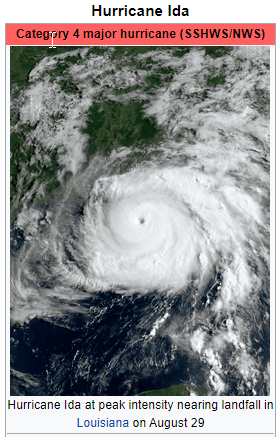
Hurricane Ida was a deadly and destructive Category 4 Atlantic hurricane in 2021 that became the second-most damaging and intense hurricane to make landfall in the U.S. state of Louisiana on record, behind Hurricane Katrina in 2005. In terms of maximum sustained winds at landfall (150 mph (240 km/h)), Ida tied 2020’s Hurricane Laura and the 1856 Last Island hurricane as the strongest on record to hit the state. The remnants of the storm also caused a tornado outbreak and catastrophic flooding across the Northeastern United States. The ninth named storm, fourth hurricane, and second major hurricane of the 2021 Atlantic hurricane season, Ida originated from a tropical wave in the Caribbean Sea on August 23. On August 26, the wave developed into a tropical depression, which organized further and became Tropical Storm Ida later that day, near Grand Cayman. Amid favorable conditions, Ida intensified into a hurricane on August 27, just before moving over western Cuba. A day later, the hurricane underwent rapid intensification over the Gulf of Mexico, and reached its peak intensity as a strong Category 4 hurricane while approaching the northern Gulf Coast, with maximum sustained winds of 150 mph (240 km/h) and a minimum central pressure of 929 millibars (27.4 inHg). On August 29, the 16th anniversary of Hurricane Katrina making landfall, Ida made landfall near Port Fourchon, Louisiana, devastating the town of Grand Isle. Ida weakened steadily over land, becoming a tropical depression on August 30, as it turned northeastward. On September 1, Ida transitioned into a post-tropical cyclone as it accelerated through the Northeastern United States, breaking multiple rainfall records in various locations before moving out into the Atlantic on the next day. Afterward, Ida’s remnant moved into the Gulf of St. Lawrence and stalled there for a couple of days, before being absorbed into another developing low-pressure area early on September 5.
The precursor to Ida caused catastrophic and deadly flash flooding in Venezuela. Ida knocked down palm trees and destroyed many homes in Cuba during its brief passage over the country. Throughout its path of destruction in Louisiana, more than a million people in total had no electrical power. Widespread heavy infrastructural damage occurred throughout the southeastern portion of the state, as well as extremely heavy flooding in coastal areas. New Orleans’ levees survived (unlike during Katrina), though power line damage was extensive throughout the whole city. There was also substantial plant destruction in the state. Numerous tornadoes were spawned by Ida as it moved over the Eastern United States. The remnants of the storm produced unexpectedly severe damage in the Northeastern United States on September 1–2. Several intense tornadoes and catastrophic flash flooding swept through the entire region, which had already been impacted by several tropical cyclones, Elsa, Fred, and Henri during July and August. The flooding in New York City prompted the shutdown of much of the transportation system.
Ida is the fifth-costliest tropical cyclone on record, and the fourth-costliest Atlantic hurricane in the United States, having caused at least $75.25 billion (2021 USD) in damages. Of this total, at least $18 billion was in insured losses in Louisiana, $250 million was in Cuba, and $584 million was from agriculture damage in the U.S., surpassing Hurricane Ike of 2008. CoreLogic estimated that Ida caused an estimated $16 to 24 billion in flooding damage in the Northeastern United States, making it the costliest storm to hit the region since Hurricane Sandy in 2012, with an estimated $44 billion in Insured loss.
A total of 107 deaths were attributed to Ida, including 87 in the United States and 20 in Venezuela. In the United States, 30 deaths were in Louisiana, 29 in New Jersey, 17 in New York, 5 in Pennsylvania, 2 in Mississippi, 2 in Alabama, 1 in Maryland, and 1 in Connecticut. There was also a remarkable number of hospitalizations and deaths in the Greater New Orleans Area as a result of carbon monoxide poisoning while using portable gas generators with inadequate ventilation, including three in a family of four in Marrero, Louisiana on September 1, 2021.